There are times in a civilisation’s history when remembering is more important than coming up with new ideas.
Today, the great land of Uttar Pradesh finds itself in such a situation.
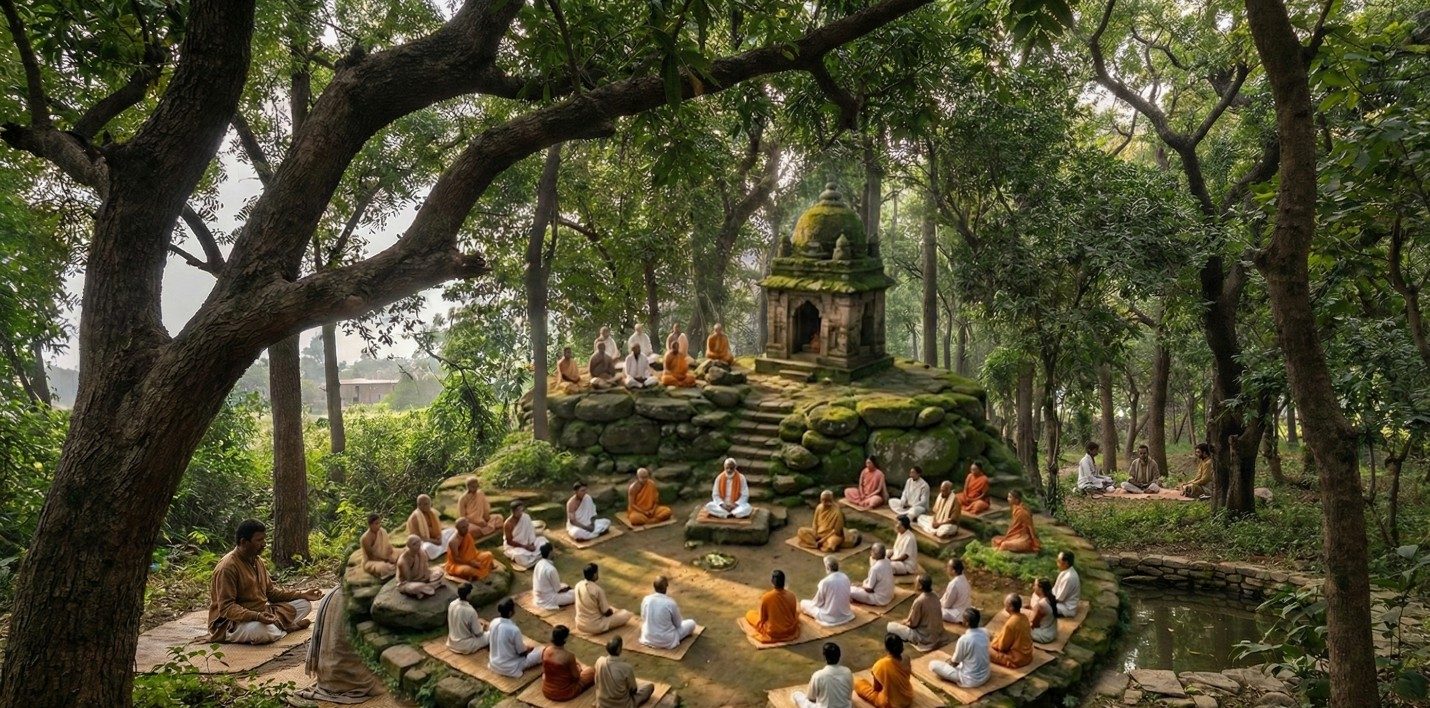
This land has never viewed trees as statistics or forests as merely carbon sinks. Vana has always been tapobhoomi, ashraya, and raksha kavacha, a living defence for society, from the banks of the Sarayu to the woodlands described in the Ramayana. People prospered when trees were conserved. Kingdoms survived because groves were respected.
It is worthwhile to take a moment to remember what our own customs teach us:
छायामन्यस्य कुर्वन्ति तिष्ठन्ति स्वयमेव च ।
फलान्यपि परार्थाय वृक्षाः सत्पुरुषा इव ॥
Trees give shade to others while standing in the sun themselves.
They bear fruits not for themselves, but for others—
like noble souls who live for lok-kalyan.
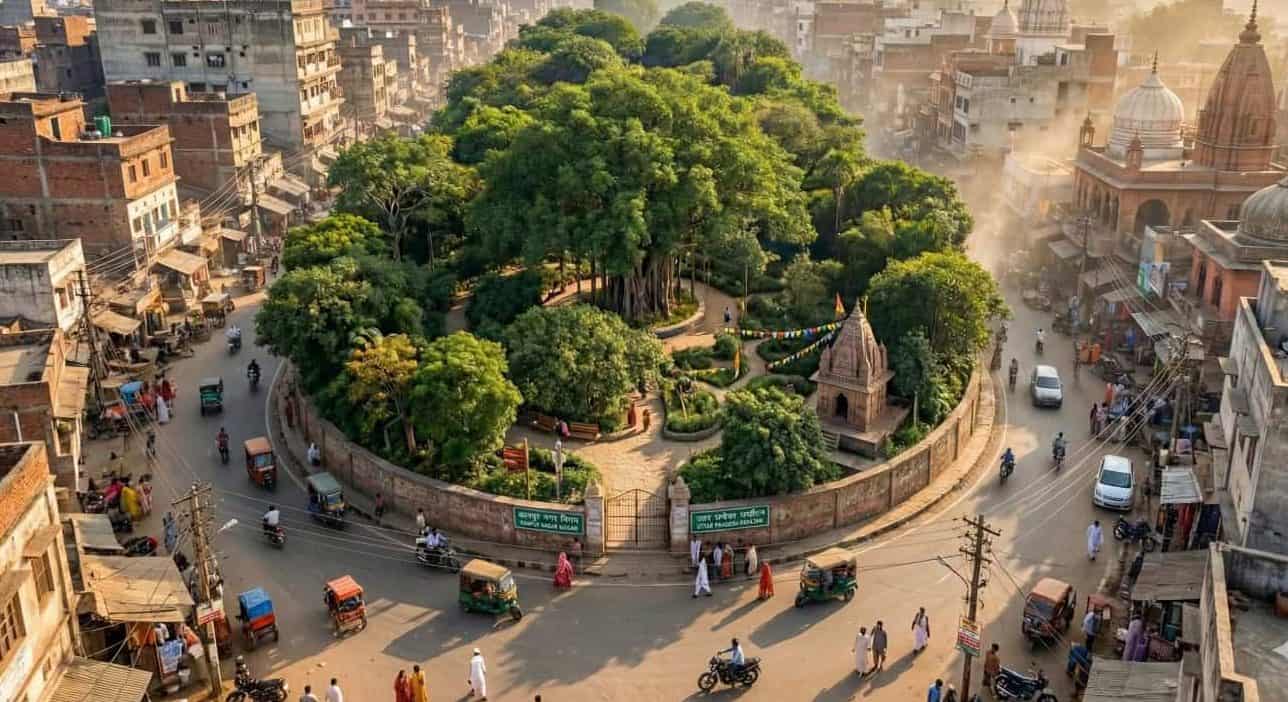
Model – Sacred Forest (Pavithra Vana) in the middle of a rural city of Uttar Pradesh
🕉️Rajdharma and the Living Landscape
Rajdharma is not limited to law and order in Bharatiya philosophy. In addition, a king is in charge of safeguarding forests, water, land, and the well-being of future generations. The wealth of the king is inextricably linked to that of his subjects, and the latter are inextricably linked to the natural world, as Kautilya reminds us.
A governance vision that gently invites every citizen to plant and care for one sacred tree is therefore not an environmental programme alone, it is an act of rajdharma expressed with humility.
Drawing directly from this understanding of civilisation, EasyForest (KALPAVRIKSHA) submitted a proposal to the Uttar Pradesh government and Shri Yogi Adityanath Ji, that envisions Sacred Forests (Pavithra Vana) that combine ecological science with spiritual continuity, Nakshatra Vana, Panchavati Vana, and Navagraha Vana, spaces where biodiversity, wellness, and belief naturally coexist.
🌏One Nakshatra Tree, One Citizen: Personal Dharma Made Visible
Every individual is born under a nakshatra, each associated in our shastras with a sacred tree. When a citizen plants their own nakshatra tree, something profound happens:
- Instead of being imposed, responsibility becomes personal.
- Care becomes ongoing rather than seasonal.
- Instead of being enforced, protection becomes instinctive.
Because of this, these trees are rarely trimmed or ignored. They are visited, watered, and prayed to. This straightforward alignment can silently result in crores of living trees, not merely planted saplings, in a state like Uttar Pradesh, where religion is lived rather than displayed.
The Bhagavad Gita reminds us:
यज्ञार्थात्कर्मणोऽन्यत्र लोकोऽयं कर्मबन्धनः
Action performed as yajna liberates; action without spirit binds.
The act of governing itself becomes sacred when planting trees becomes yajna.
🌳Panchavati: From Itihasa to Living Villages
Panchavati is not a symbol of nostalgia. It’s common sense. Five carefully selected trees provide shade, medicine, water retention, wildlife, and peace. Panchavati, according to Bharadwaja Muni, was the forest that provided Sri Rama with both material and spiritual sustenance during Vanavasa.
Encouraging one Panchavati grove per family or community is to restore micro-ecosystems where:
- Elders gather in the shade
- Children grow with trees as companions
- Cities restore the groundwater balance and natural cooling.
This is development without concrete. Wellness without hospitals. Culture without slogans.
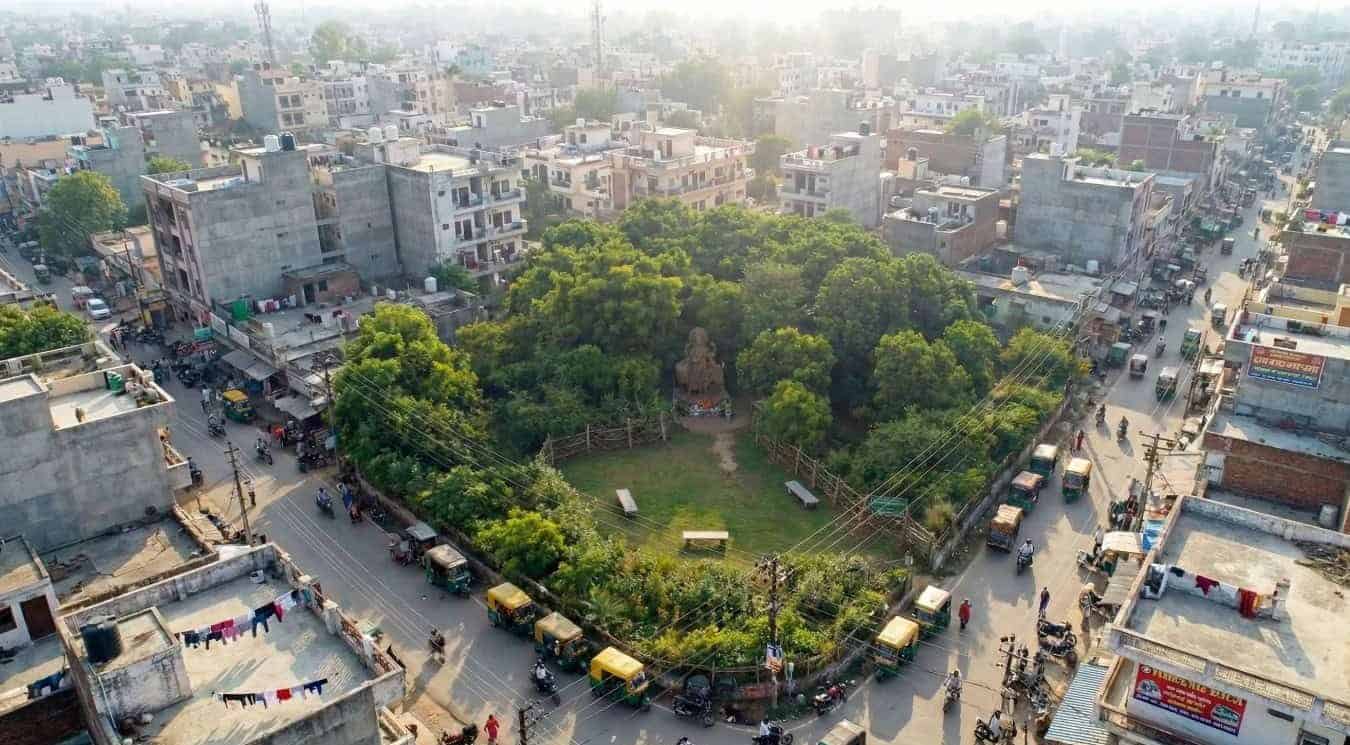
Model – Sacred Forest (Pavithra Vana) in the middle of an urban city of Uttar Pradesh
🌿Why This Works Especially Well in Uttar Pradesh
UP is uniquely positioned for such a movement because:
- High religious participation across castes and communities
- Strong networks (temples, anganwadis, schools, panchayats)
- Cultural respect for elders and rituals, which sustains long-term care
- Youth participation when tradition is framed as pride, not obligation
Here, a tree is not “planted and forgotten.” It is named, visited, worshipped, and protected.
🙏Governance with Empathy Builds Legacy
When environmental action speaks the language of faith and culture, leadership appears empathetic, rooted, and visionary. A program built around nakshatra trees and Panchavati groves naturally projects the image of a government that:
- Understands the soul of its people
- Respects tradition while solving modern problems
- Cares for health, climate, and culture together
Such an initiative can quietly but powerfully enhance the people-centric image of Shri Yogi Adityanath Ji, positioning environmental care not as policy alone, but as seva.
📜 Smriti Speaks Softly, Yet Firmly
When it comes to trees, our smritis are clear:
दशकूपसमा वापी दशवापीसमो ह्रदः ।
दशह्रदसमः पुत्रो दशपुत्रसमो द्रुमः ॥
Ten wells equal one pond,
ten ponds equal one lake,
ten sons equal one tree.
A tree, once planted and protected, serves generations, long after administrative tenures change.
🌏Vision for Uttar Pradesh: A People-Led Sacred Forest Movement
Statewide Reach:
Build a people-led sacred forest movement that touches every district, every village, and every family of Uttar Pradesh.
One Citizen, One Sacred Tree:
Enable each citizen to plant and nurture one sacred tree, beginning with Nakshatra Vanas that create personal spiritual connection, lifelong responsibility, and natural protection of trees.
One Panchavati per Family or Community:
Families and community groups should be encouraged to create Panchavati groves as living spaces that provide social harmony, ecological balance, health benefits, and shade.
Strategic Public Spaces:
Develop sacred forests across temple lands, village commons, school and college campuses, hospitals, government institutions, and urban public spaces, ensuring visibility, accessibility, and continuity.
Structured & Sustainable Approach:
Support the initiative through scientific ecological planning, native species selection, community participation, and long-term stewardship, rather than short-term plantation drives.
Enduring Outcomes:
Quietly restore the environment, strengthen public health, and reaffirm cultural identity, not through enforcement, but through faith-anchored participation that sustains itself across generations.
Sometimes, the greatest governance legacy is not what is built,
But what is grown 🌿
🌱 Conclusion: A Living Legacy of Rajdharma
Devotion transforms a single tree into more than just shade; it becomes a guarantee for the future.
When every family protects a little grove and every citizen cares for a sacred tree, Uttar Pradesh becomes closer to an old ideal where nature, people, and the ruler coexist peacefully. The social and spiritual fabric that holds society together is also healed by such a vision, in addition to the land.
This is the silent, persistent, and profoundly Indian expression of Vasudhaiva Kutumbakam through action, leaving a legacy that is cultivated in living forests rather than inscribed in stone.
Leave a Reply